Finding New Ideas in Uncertain Times
In this half-day session, the Creative Capacity Lab partnered with McCombs School of Business leadership to surface fresh approaches to a familiar challenge using collective brainstorming techniques and rapid cycles of divergent and convergent thinking.
A SPARK + A FRAMEWORK
When the McCombs Dean's Office reached out to the Creative Capacity Lab, they were clear about what they needed, and it was two distinct things. The first was a spark. Leadership knew that unlocking new thinking often
requires bringing in an outside perspective. The same group of smart, experienced people, working on the same familiar challenge, tends to arrive at the same familiar answers. By inviting the Creative Capacity Lab, McCombs created conditions for genuine surprise. New tools, new voices, and a deliberately different way of working gave the group permission to see their own questions differently.
This “shortlist sprint” workshop leveraged the entire leadership group during an annual retreat with the goal of handing over a “shortlist” of vetted concepts to the specific team charged with implementation.
The McCombs School of Business at The University of Texas at Austin is one of the nation's topranked business schools, preparing students to lead organizations, create value, and make an impact across industries. With world-class faculty, a deeply connected alumni network, and a long legacy of innovation, McCombs plays a central role in shaping the future of business education in Texas and beyond.
The second was a framework. The Dean's Office understood that innovation doesn't happen spontaneously. They wanted something reusable, a structured set of tools their team could return to when the next hard question comes along. The goal wasn't just a good day. It was building a repeatable practice for thinking creatively in uncertainty. That combination, the jolt of an outsider's spark paired with scaffolding sturdy enough to use again, shaped how we designed the session.
Despite its strong standing, McCombs leadership faced a challenge familiar to institutions everywhere: finding new energy, language, and vision around fundraising — particularly how to frame existing programs for potential donors and identify new opportunities worth pursuing. The question wasn't just what to fund, but how to think about what's fundable. After a short sprint session with leaders, the development team took concepts into their workflow to look at feasibility and strategy.
“Can't quite remember the last time I had universal, positive praise for a session…but that ticker got reset yesterday.”
— Creative Capacity Lab Participant from McCombs School of Business
Design Thinking Strategies
01
Working Analog
Working by hand externalizes thinking, slows down the rush to certainty, and makes ideas tangible and moveable.
04
Collaborating Across Roles
Creating conditions for cross-functional insight.
02
Time-Boxing
Short sprints create productive constraint.
03
Thinking in Analogies
New shared language breaks teams out of thinking ruts.
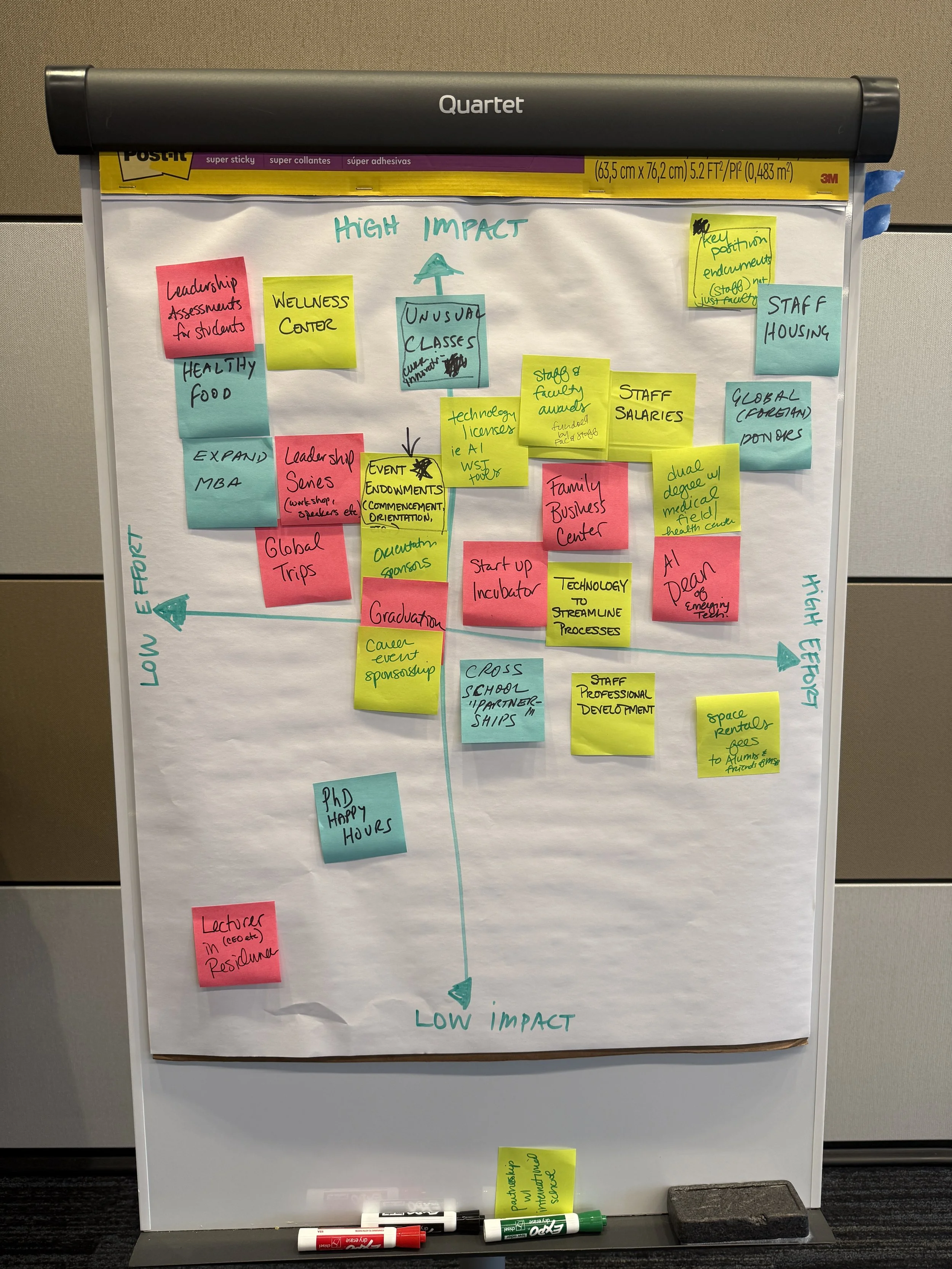
We generated a lot, then made hard choices.
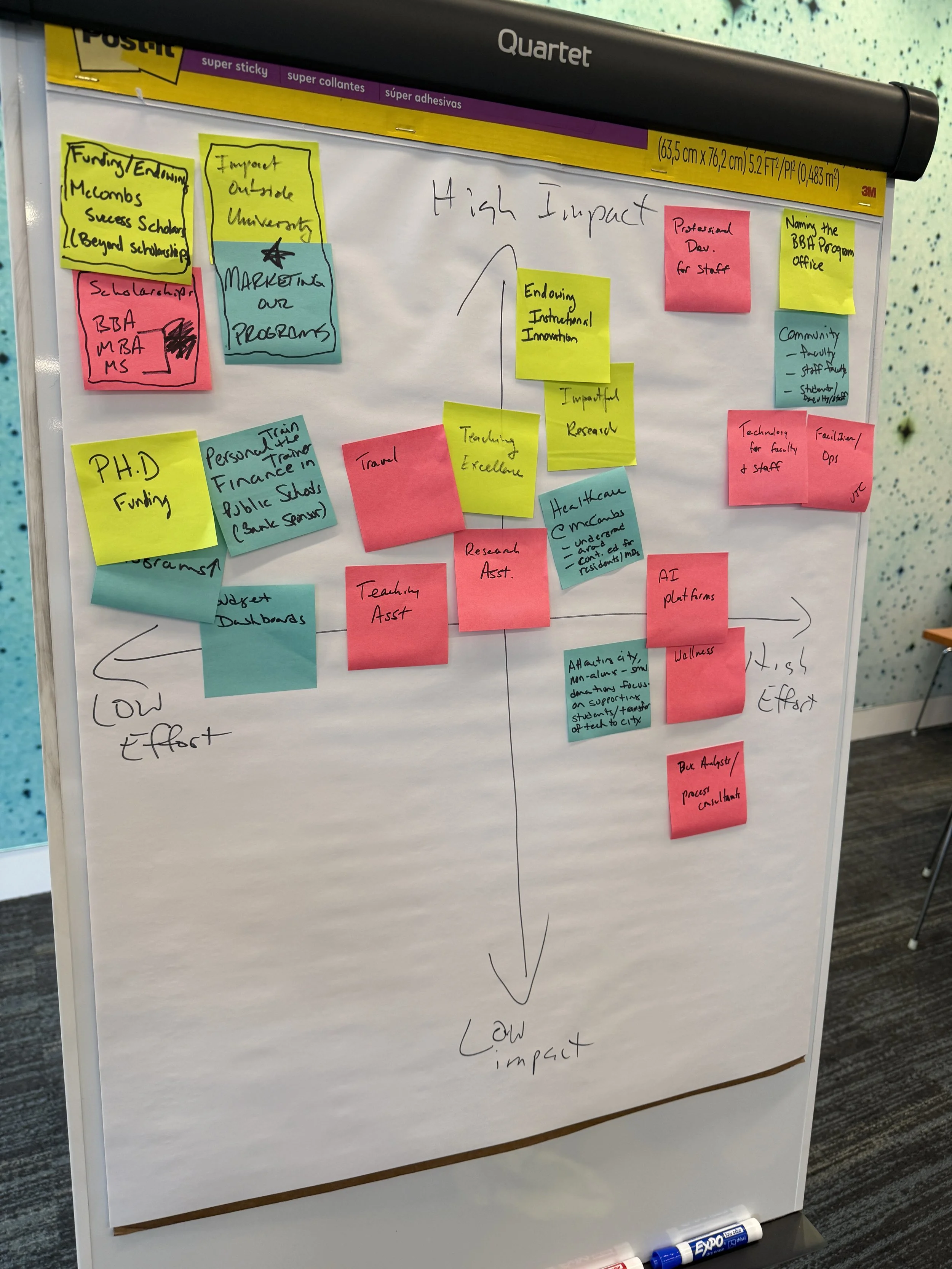
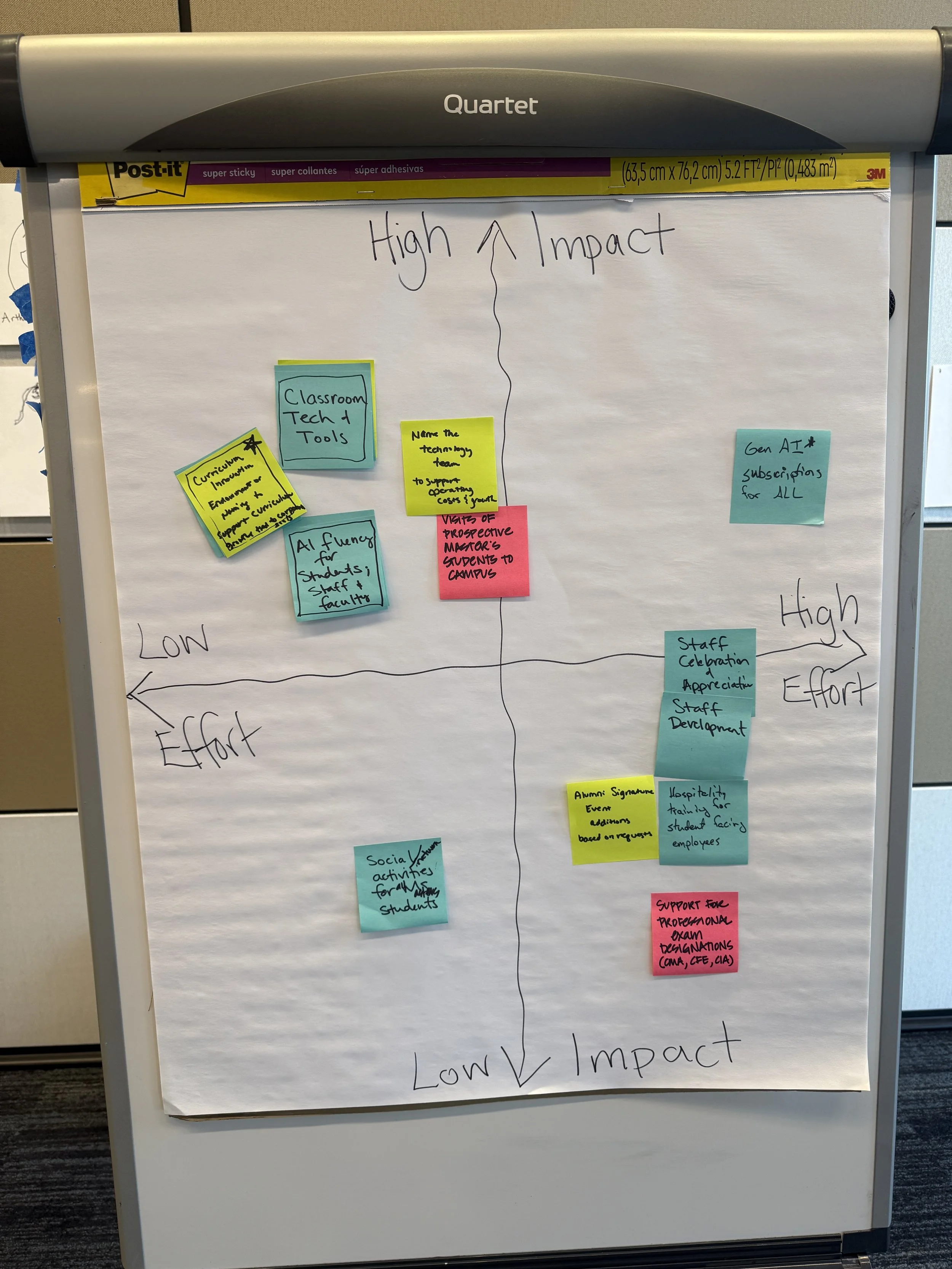
Working in table teams, McCombs leaders generated dozens of ideas for fundable programs — from leadership development initiatives and alumni events to staff wellness programs, AI tools for students, curriculum endowments, and everything in between. Then came the harder work: sorting those ideas by impact and effort, surfacing the ones worth pursuing, and choosing just one per table to develop further.
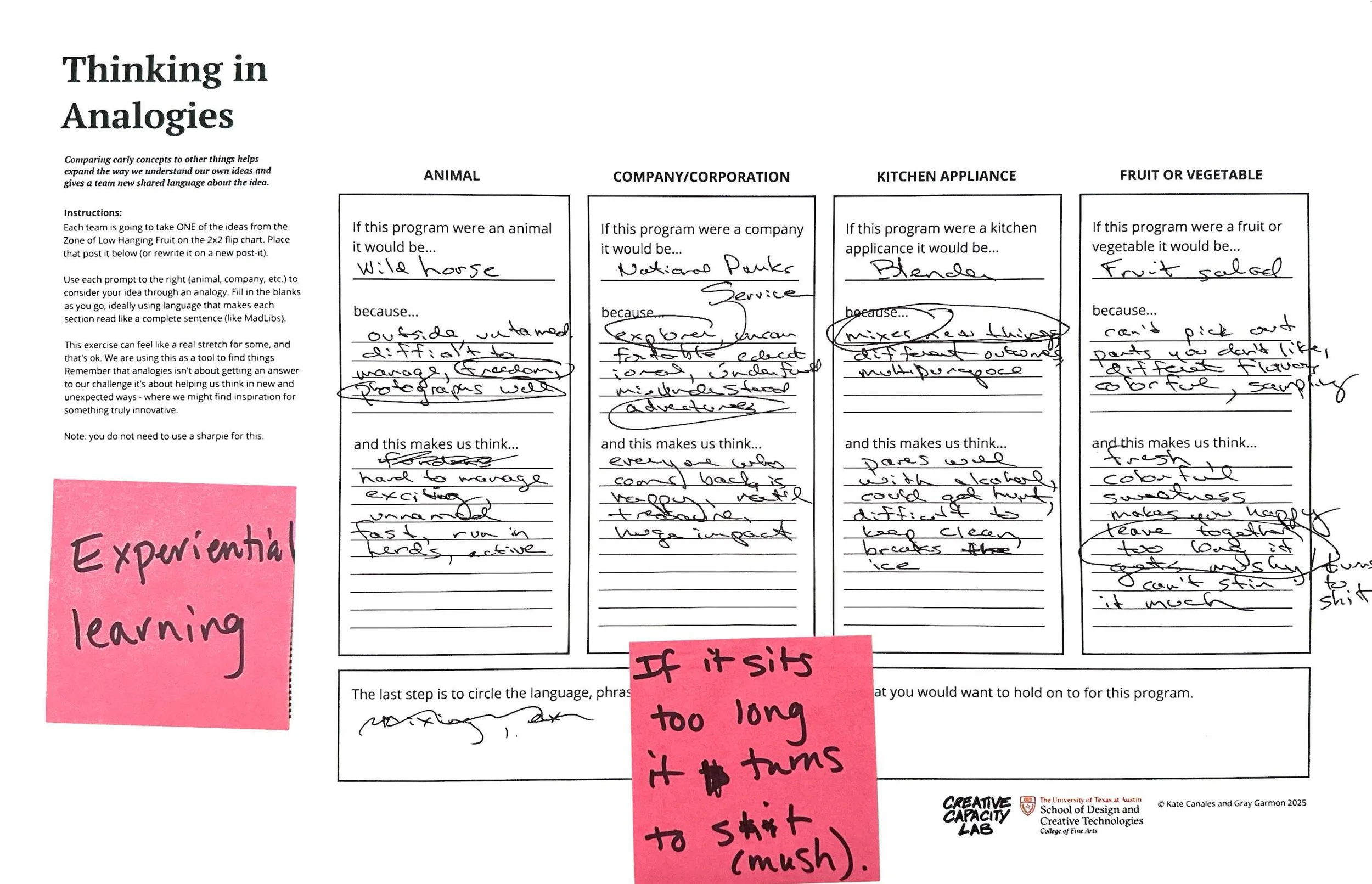
We looked at familiar ideas from unfamiliar angles.
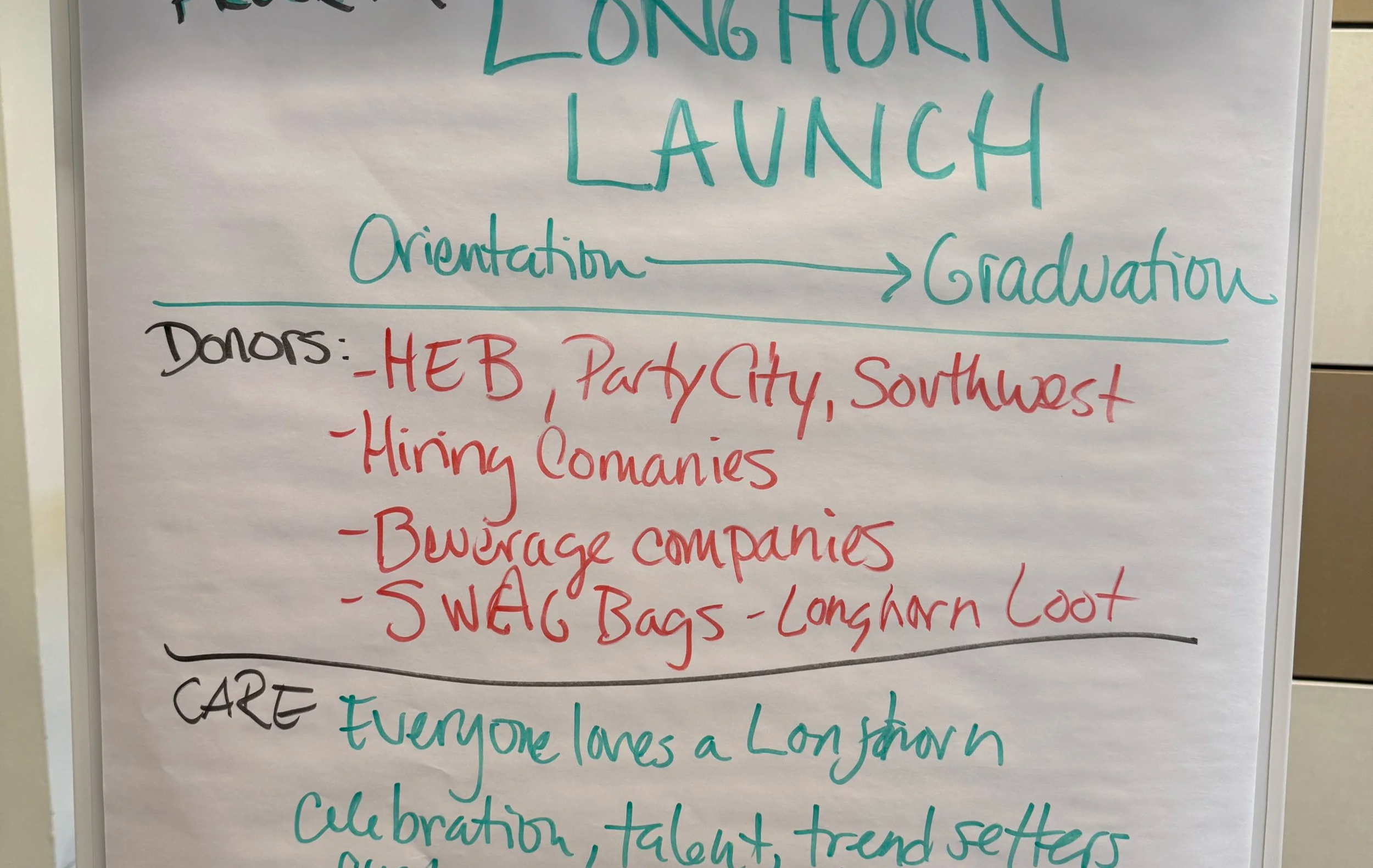
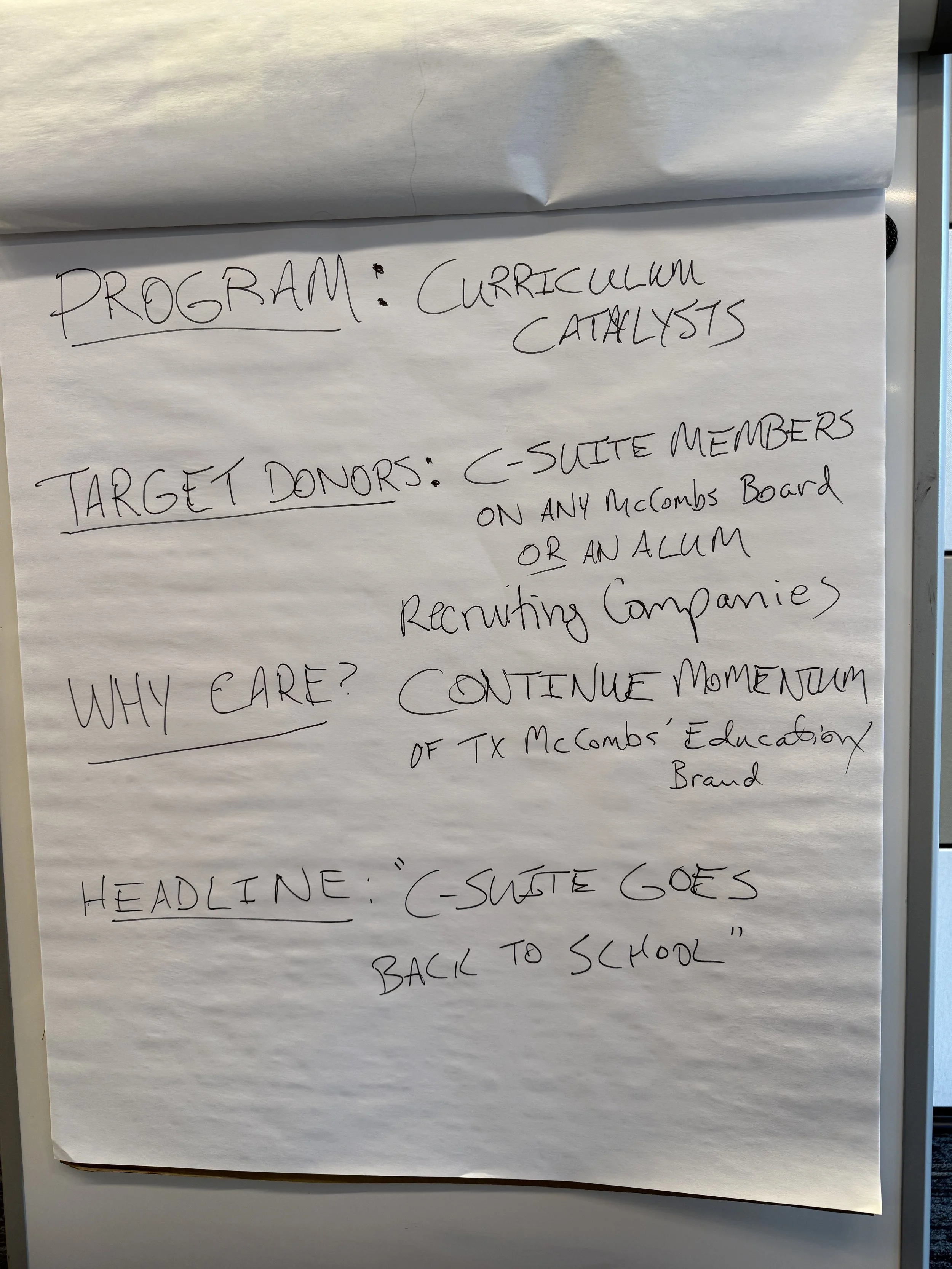
The analogies exercise was, by design, a stretch. Teams compared their chosen programs to wild horses, golden retrievers, mangoes, blenders, and Southwest Airlines. One team working on experiential learning noted: "If it sits too long, it turns to mush" — capturing a real urgency about the need to act before momentum fades. Another team, exploring a curriculum innovation endowment, landed on the language of "forward thinking, connecting/bridging, flexibility/adaptability, alignment between academics and corporations" — exactly the donorfacing framing they'd been searching for.
The pitches made it real.
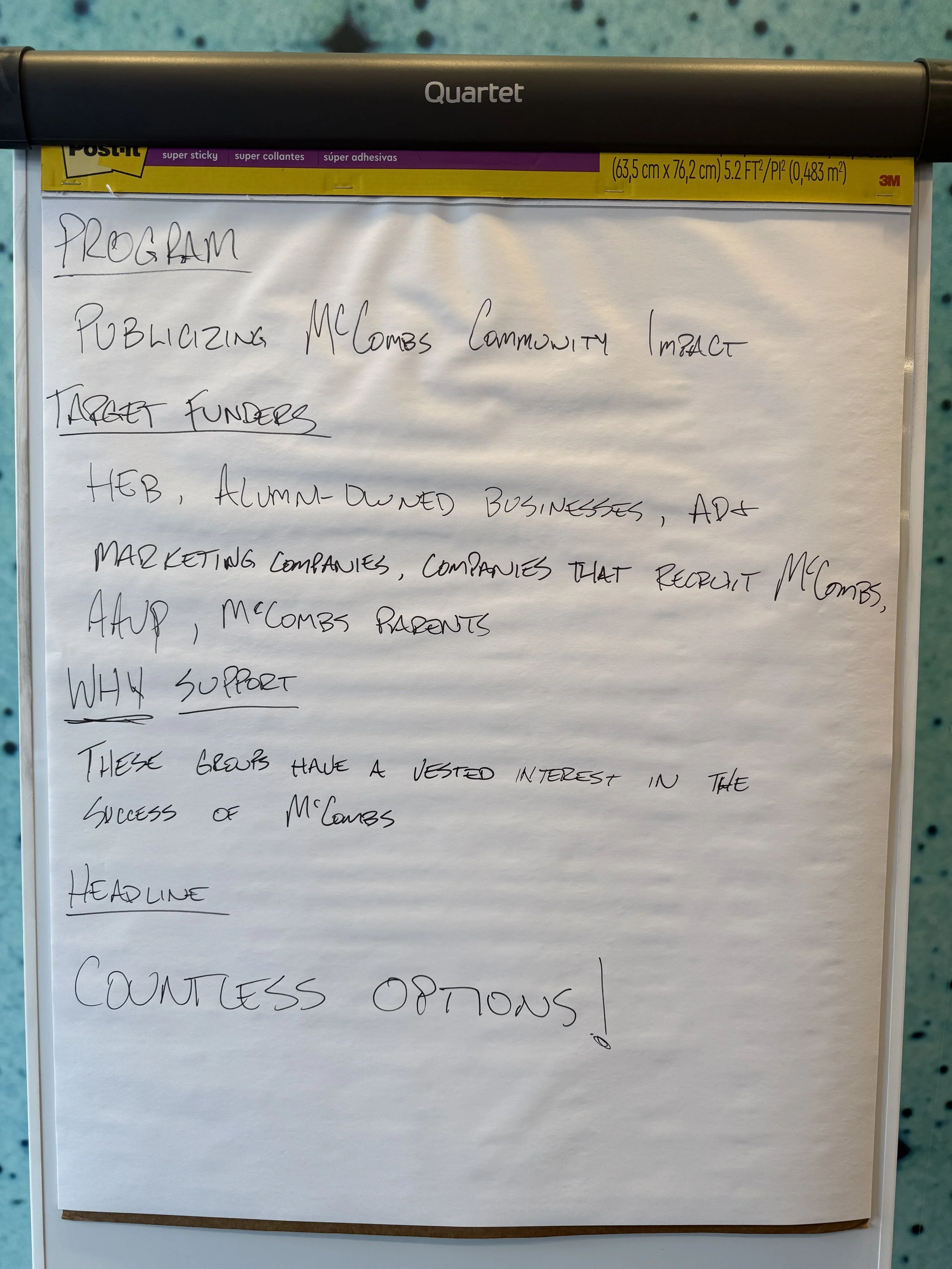
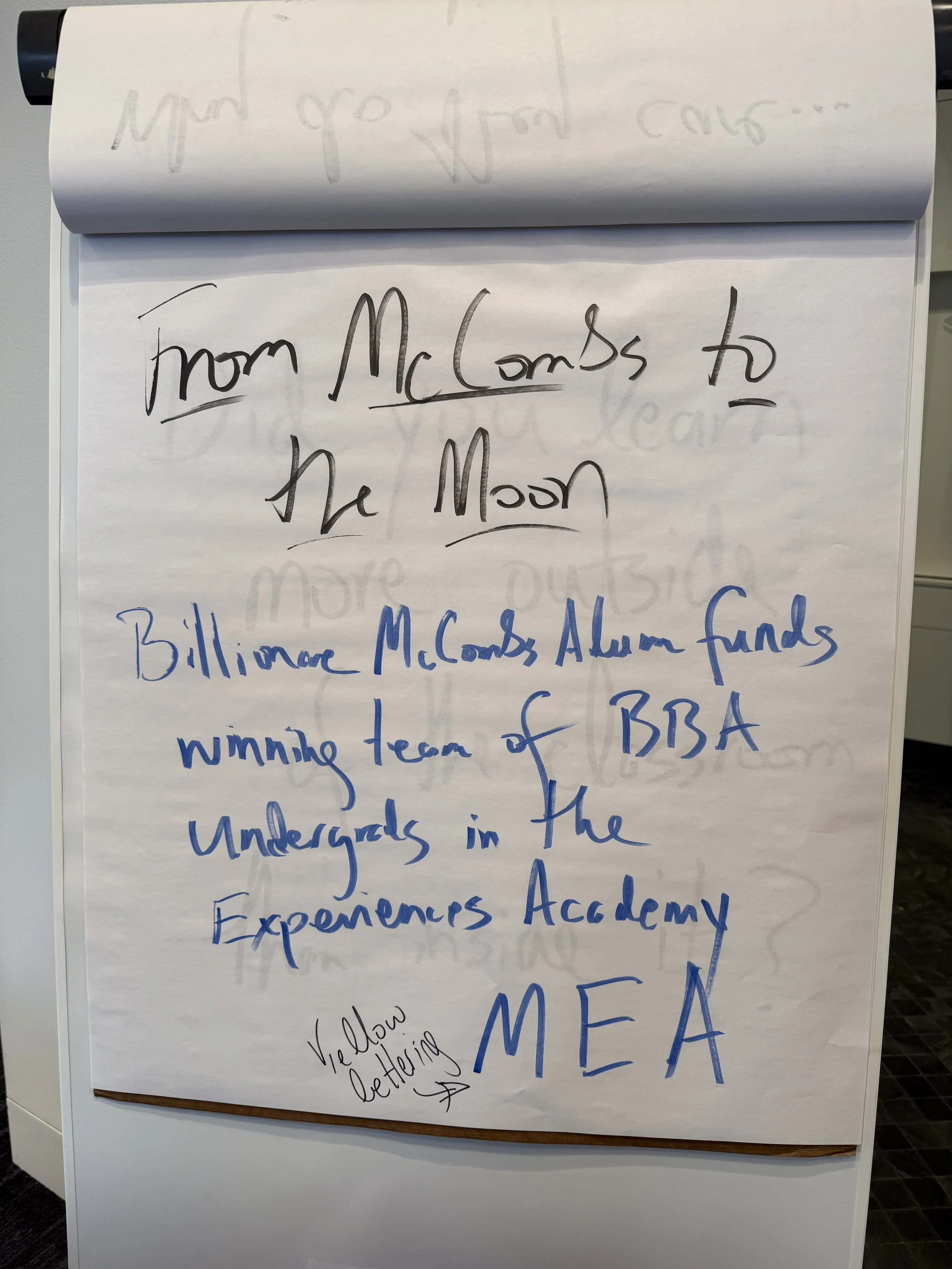
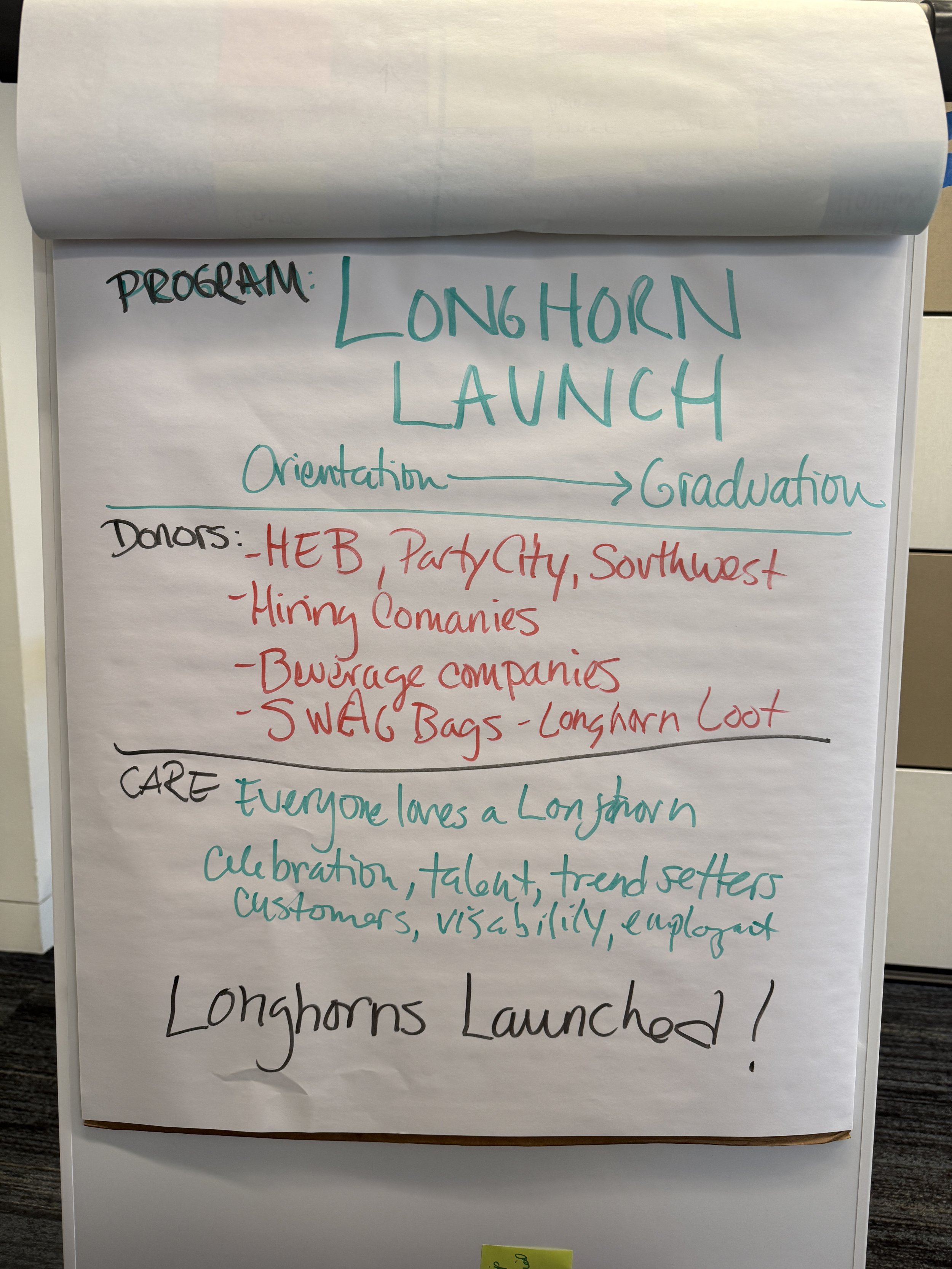
By the end of the session, every table had a named program, a target donor audience, a reason those funders might care, and a headline to rally around.
"Fun, well-paced, useful, fresh…just some of the adjectives I heard. I'm feeling quite grateful for your time and expertise."
— Creative Capacity Lab Participant from McCombs School of Business